Bringing It In
Our previous issue asked how a stranger decides you are worth a meeting. This one examines three independent studies exploring the impact of the conditions you seek to win trust in.
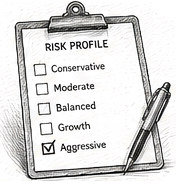
The first, from Economica, ran an incentivized money game with 7,236 people across six countries. Appetite for risk, measured with real gambles rather than a questionnaire, explained 1.3 percent of who trusted a stranger. A person's own sense of fairness, on the other hand, explained 12.5 percent. The risk profile in your onboarding packet is not measuring this.
The second, from the Journal of Public Economics, randomly sorted 1,345 Israelis into two groups and sent one of them into the stock market for up to seven weeks. In the group left alone, 23.8 percent said most people can be trusted. In the group sent to the market, 29.7 percent did. The gain showed up most clearly among the investors whose shares fell.
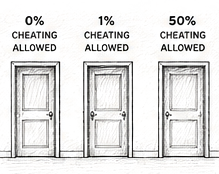
The third, from the American Journal of Political Science, put 264 people in groups where one member could quietly pocket part of the pot. The rules stopped that every time, or let it through 1 percent of the time, or 50 percent. Nobody was told what happened. Asked afterward to entrust money to an uninvolved stranger, the people who had sat under the weaker rules gave less. The 1 percent version cost nearly as much as the 50 percent version.
I picked these three because each one takes something you thought was yours to earn and shows it was significantly impacted before you met. Each also leaves you one move. The third study's is the smallest: write a plain paragraph on who holds the money and who checks your work, and put it in front of people before they ask.
Three more great studies on trust next week.

Sources · Issue 6
About This Issue
Three peer-reviewed studies on how trust is built, retold in plain language. The "at your desk" sections are our editorial application, not claims made by the researchers.
Where a client's trust is formed before you meet: the disposition they arrive with, what owning a stake in the market does to it, and what an unanswered question about the system costs you.
In our previous issue we covered three studies on winning a stranger's trust.
Risk Tolerance is not Trust
Seven thousand people in six countries entrusted real money to a stranger. What predicted how much they sent was not their appetite for risk.
Kovacs, R., Dunaiski, M., Galizzi, M. M., Grimalda, G., Hortala-Vallve, R., Murtin, F., & Putterman, L. (2024). The determinants of trust: findings from large, representative samples in six OECD countries. Economica, 91(364), 1521-1552. Open access: doi:10.1111/ecca.12549
Somewhere in your onboarding packet is a page that asks a new client how she would feel about a portfolio that fell twenty percent in a year. Her answer gets scored, filed, and used to defend an allocation for the next decade.
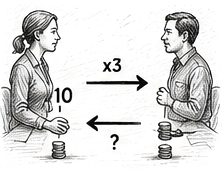
It is a useful page. It is not a measure of whether she will trust you. Economists have now separated those two quantities using real money and a sample large enough to speak for six countries.
The experiment
The instrument is a game economists have been running since 1995, and its design is what makes the result worth your time to read about. Two strangers each receive a stake. The first player may send any part of hers to the second. Whatever she sends is tripled on the way across. The second player then decides how much to send back, and nothing obliges him to send a thing. Whatever he keeps, he keeps.

Every unit that comes back is a unit he could have pocketed instead. Keeping the lot is the move that maximizes his money, and he knows she knows it. So the amount she sends is not a bet on a machine or a market. It is a priced wager on a stranger's character.
Rachel Kovacs and six colleagues ran that game with 7,236 adults, sampled to represent Germany, Italy, Japan, Luxembourg, the United Kingdom and the United States. Each first player held 10 units and could send any part of it. The payouts were real, settled afterward on one game chosen at random.
They then put the same people through two more tasks. In one, a player divided a stake with an anonymous stranger who had no move to make and no way to pay anything back. Giving there measures nothing except the player's own sense of fairness. In the other, players chose among six gambles with real money attached, which measures appetite for risk the way a casino measures it rather than the way a questionnaire does.
What they found
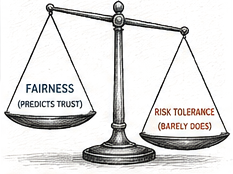
Fairness won, and it was not close.
Risk tolerance and trust are separate traits. A client can be entirely comfortable watching her portfolio fall twenty percent and still want to check every number you send her, and the questionnaire that measures the first tells you almost nothing about the second.
How much a player gave away in the sharing task was the strongest predictor of how much she entrusted to a stranger, accounting for 12.5 percent of the variation between people. What she expected to get back accounted for 6.6 percent. Her appetite for risk, measured with live money, accounted for 1.3 percent.
What This Means at Your Desk
Stop reading the risk questionnaire as a trust questionnaire. A high score tells you she can carry volatility. It does not tell you she will carry a quarter without a phone call. Two clients with matching risk profiles can need completely different amounts of contact, and the packet will not sort them for you.
Signal fairness, not daring. Fairness was the trait that traveled with trust, and it is the one you can actually show: fee transparency, the credit you hand back before anyone asks for it, the conflict you disclose while it is still yours to disclose. None of that requires knowing anything about the client in front of you, which is the point, because you will not know much for a while.
Do not typecast. Roughly 85 percent of the difference between a trusting client and a guarded one went unexplained here, and that is after six national samples with money on the table. Treat the guarded client as someone you have not learned yet rather than a type you have already scored.
The bottom line
The profession owns a well-developed instrument for measuring how much loss a client can bear and none at all for how much doubt she carries. You can look up the first. The second you have to earn your way into.


Seven Weeks in the Market Made People More Trusting
A randomized trial put 1,345 Israelis into the stock market. The ones whose shares fell came out just as trusting as the ones who won.
Jha, S., Shayo, M., & Weiss, C. M. (2025). Financial market exposure increases generalized trust. Journal of Public Economics, 242, 105318. doi:10.1016/j.jpubeco.2025.105318
For most of a century the research treated generalized trust as scenery. You absorbed it from your parents and your country by roughly the age of twenty, and after that it was a fact about you, like handedness. Nothing was thought to move it.
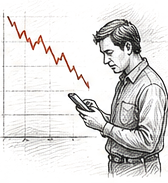
A trial in Israel put that assumption in front of a randomizer. It did not survive seven weeks, and the people it moved furthest were the ones whose shares lost money.
The experiment

Saumitra Jha, Moses Shayo and Chagai Weiss surveyed 1,418 Israelis, dropped 73 for incomplete or contradictory answers, and randomly assigned the remaining 1,345 to two groups. A control group of 309 was left alone. The other 1,036 were encouraged onto a simple survey-based platform where they held a real position in a real listed stock.
Every week for up to seven weeks, those investors received the closing price of what they owned and a valuation of their portfolio. Every week they had one decision to make: hold, or buy or sell up to a tenth of the position before Monday's open. Sitting out was not free. Register no decision at all and you forfeited the tenth you could have traded. Most of them complied and kept complying, with 80 percent trading in all but one week.
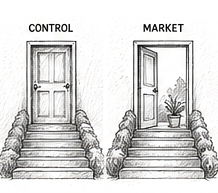
Then the researchers asked a question that has nothing to do with stocks, the one the World Values Survey has been asking for decades. Would you say that most people can be trusted, or that you need to be very careful in dealing with people?
That question is not about markets, brokers, or the platform they had been using. It has no financial content at all. It is the standard measure of how much credit a person extends to strangers in general, and it is the item researchers have used for half a century to rank whole countries against each other.
What they found
In the control group, 23.8 percent said most people can be trusted, close to where Israel lands in the international surveys. Among those assigned to the market, 29.7 percent did, a gain of 5.9 percentage points and about a quarter above the control group's level. A quarter of the way up a trait that was supposed to be fixed by adulthood, in seven weeks, on a small position in a single stock.
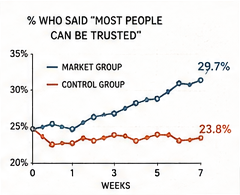
The comparison counts everyone assigned to the market, including the ones who never got around to trading. That makes it a conservative reading: what the number measures is the effect of offering the experience to a group of people, not the effect on the subset who take it up and follow through.
Then comes the result that should interest anyone whose clients watch a balance move on a screen.
The researchers split the treated group by what the stock actually did. For 327 of them the price was down by the day they cashed out, for 709 it was up, with the swings running from about 12 percent down to about 16 percent up. The obvious worry about handing a nervous client market exposure is that a bad run teaches them the world is against them. If the effect ran on the pleasure of making money, the first group should have shown nothing, or a backlash.
The clearest result in the study came from the people who lost money: their trust in others rose, and the finding was solid. Among those whose shares gained, trust rose by less, and by a margin the study could not separate from chance. Whatever was driving this, it was not the pleasure of winning.
Why it works
The authors read it as learning by doing. Buying a share means handing your money to a large group of strangers you will never meet, on the understanding that they have reason to look after it, and then watching that arrangement run. What you learn is that a system of strangers can be relied on to behave as described. A price that falls does not contradict the lesson. It confirms it, as long as the machinery around the price keeps working.
The effect was strongest among committed partisans at both ends of a polarized political spectrum, which is to say among the people with the least standing reason to give anybody the benefit of the doubt. The clients hardest to win over were the ones it moved most.
What This Means at Your Desk
Read the funding delay as a cost, not a courtesy. Advisors slow-walk hesitant prospects out of decency, letting them sit in cash until they feel ready. This study says the readiness is partly manufactured by the experience they are being kept out of, and that the waiting room is not a neutral place to leave someone. Opening a real position, at a size that will frighten nobody, is the beginning of the thing you are waiting for.
Own the down weeks instead of managing around them. The strongest result here came from investors who watched their money fall and finished more trusting. That worked because the system around them kept behaving: the price arrived on schedule, the position sat where it was supposed to sit, the next decision was still theirs. A drawdown handled in the open is not damage you are containing. It is the demonstration.
Report on a rhythm the client can predict. These investors got a price and a valuation every week without asking for either. Regularity is what makes a system feel like a system. An update the client has to request teaches a different lesson.
Give the client something to decide. Every week these people held or traded. Participation is not the same as being kept informed. Find the real, bounded decision your client can own, then let them own it on schedule.
The bottom line

The scope here is narrow and worth stating plainly. This is trust in people at large, measured on one survey question, in one country, weeks after the fact. Nothing in it says your clients will like you more.
What it says is that the ground is not fixed. The client with money in the market is standing somewhere different from the client sitting in cash, and you decide how long they wait.
People Trusted Less When the Rules Left an Opening
Knowing the rules left an opening was enough to make them hold back from strangers who had done nothing.
Martinangeli, A. F. M., Povitkina, M., Jagers, S. C., & Rothstein, B. (2024). Institutional quality causes generalized trust: experimental evidence on trusting under the shadow of doubt. American Journal of Political Science, 68(3), 972-987. doi:10.1111/ajps.12780
Halfway through a first meeting, a prospect asks who actually holds the money. You name the custodian, she nods, and you both move on. It reads like housekeeping.

A lab in Munich put a number on that question.
The experiment
Andrea Martinangeli and three colleagues brought 264 people into the Max Planck lab across 11 sessions and ran them through two stages. The second stage was the measurement. The first was the point.
In stage one, everyone put money into a common pot that one of their number was responsible for handing back out. The software let that person enter a smaller figure than the group had actually contributed and keep the difference. What varied between sessions was the strength of the check on it. In one version the software caught any shortfall and refused it, every time. In a second, a shortfall slipped through one time in a hundred. In a third, half the time.
Here is the detail the whole study rests on. Participants were never told what the person handling the pot actually did. No feedback, no reveal at the end of the stage, nothing. They left stage one knowing only how strong the rules around them had been.
Then the groups were dissolved. Everyone was told so, and everyone was re-paired at random with a different member of the session. Each player held six euros. The sender could pass any whole part of it, the amount doubled on the way across, and the receiver could return as much or as little as he liked, including nothing. In pure cash terms his best move was to keep every cent.
So her decision measured one thing only: what she now expected of a stranger. The re-pairing is what makes that clean. Her new partner had not been in her group, had done nothing to her, and knew nothing about what she had been through. Anything she held back could not be payback.
What they found
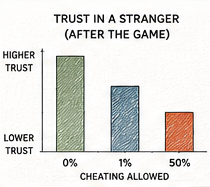
Where the rules held every time, senders passed about 3.24 euros of their six.
In the sessions where a shortfall could slip through one time in a hundred, they passed about 72 cents less.
In the sessions where it could slip through half the time, they passed about 1.18 euros less, a drop of roughly a third.
The two weakened conditions were not reliably different from one another. Fifty percent came out worse than one percent on the point estimate, by a margin the study could not separate from noise. Nearly all of the cost was already paid at one percent.
The authors went after the obvious alternative, which is that people whose rules had been weaker simply expected to be poorer and behaved accordingly. Beliefs about what the manager had done did shift with the conditions, and those beliefs did affect how much people sent. They did not account for the drop. The effect of the environment survived controlling for what people believed had happened to their money.
Nothing had gone wrong, as far as anyone in the room knew. What moved the money was the knowledge that the rules left an opening, carried by people who never learned whether it was ever used, and charged to a stranger who could not have been involved. The opening was the whole of the treatment.
What This Means at Your Desk
The client is pricing the safeguards, not you. In this experiment the doubt attached to the rules of the room rather than to any person inside it, and the people who paid for it had done nothing. A prospect who has never met you arrives with a view about how well your corner of the business is checked, and that view sets her opening position. Your character is not the variable she is working with yet, because she has no reading on it.
A small opening prices like a large one. One percent cost nearly what fifty percent cost, so what mattered was that an opening existed rather than how wide it was. A fee line you cannot account for in a sentence, a custody arrangement nobody has walked the client through, a report that arrives on no fixed schedule: each leaves a question she cannot close on her own, and here the narrow questions were priced almost exactly like the wide ones.
Show the machinery, not the record. A clean history cannot answer a question that was never about you in the first place. The mechanism can: who holds the assets, who checks your numbers, what happens if you are wrong and who learns about it without your say-so. That is the version of the rules that held every time, and it is the one condition here that people rewarded.
Say it before you are asked. Nobody in the experiment could find out what had actually happened in their group, so they filled the gap with a pessimistic guess, and the stranger across from them paid for it. A client does the same with anything you have not explained. Write that paragraph once and send it before anyone thinks to ask.
The bottom line

Trust does not reach your office out of your own conduct alone. It arrives filtered through what the client believes about the system you work inside, and this experiment says that belief is set by what the system leaves open rather than by anything that has actually happened in it. Nothing went missing in Munich, as far as the participants knew. It was enough that the rules left room, and enough that nobody could settle the question either way.
The awkward half is that you open each relationship holding a position you did not take, set by conditions you did not create and cannot argue your way out of. The useful half is that the same mechanism runs in your favor, on the parts you do control. A client who can see how your side of it works has been handed the version of the rules that held every time, and in the only test anyone has run of this, that version was worth about a third of what was on the table.
LIVE ZOOM WEBINAR · AUGUST 28, 2026
60 MINUTES | 11:00 AM PT – 2:00PM ET
Our first Humanity Labs Ask Me Anything was a smashing success, filled with sharp questions and honest answers. This time, come see it live, in person. Submit your questions in the registration and don't hold back — you'll get nothing but unvarnished Andrei in return. Join us for the next AMA on Thursday, August 28, at 11am PT / 2pm ET.
